
TS-PASS: Methodology to Help Reduce Health Costs and Improve Outcome Effectiveness
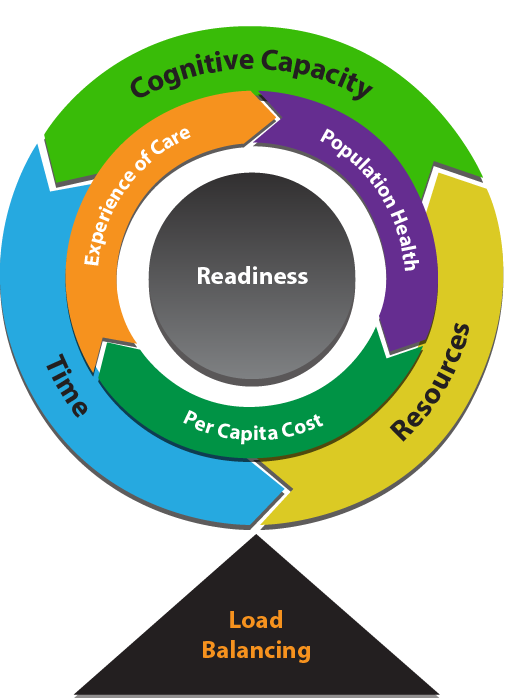
A goal of the Military Health System (MHS) is to recapture patients presently lost to the network. In order to meet this goal, the MHS must be able to adequately and safely deal with the increased patient volume. We believe that better management of the entire Healthcare Team’s time is crucial to meet this goal. Factoring cognitive capacity offers a unique way of ensuring task execution – making sure critical work is done to keep the patients safer and healthier with the limited time and resources available in the MHS while paving the way for Accountable Care.
The Tri-Service Patient Acuity and Staff Scheduling (TS-PASS) team initially focused on technologies as a solution to workload management. A recent review of health systems and clinical literature revealed a process methodology that has led to the reduction of hospital readmissions and staff workload in the civilian sector. The methodology harnesses cognitive load balancing and ties available physical resources to patient care requirements in order to improve staff-workload management while also improving care quality, patient safety and satisfaction, and reducing readmissions. This perfectly complements the MHS goals of reducing per capita costs and improving the experience of care. Funded by an award administered by the Telemedicine and Advanced Technology Research Center (TATRC), this project team is applying the methodology in the Naval Medical Center San Diego’s (NMCSD) Pediatric clinic. They are accomplishing this by conducting a careful analysis of historical workload data from Pediatrics and applying this information to improve task execution of the newly integrated Medical Home Team preventing readmissions and lowering resource utilization.
The key tool is the cognitive load balancing concept that would address the assignment of resources (for a physical resource model) to meet patient care demands. Using cognitive load modeling and balancing, the current workload management process transitions the solution to a cognitive resource model to maximize clinical effectiveness and efficiency.
The project team is currently supporting a retrospective quality improvement project in NMCSD’s Pediatric Clinic. Since the project could scale very quickly, we would plan to expand to a research project that would utilize concurrent data to optimize resource allocation proactively. A concurrent analysis of data using existing information systems would complement the present review of retrospective data. The team could be ready to start the concurrent model within two months of launch and provide the “load balancing” capabilities within three months after that. Initial results should be ready to review within ten months.
The initial costs for this project include the cost of deploying a team to teach the key methods and implement the methodology. Specific costs would be based on the team size and budget parameters, along with the level of research desired. The cost estimates would range from $2 million to $7 million. The annual training cost is $240,000 per inpatient facility and $60,000 per outpatient facility. However, please note that based on sizable anticipated cost savings (with an ROI of 500% based on a project business case already developed).
6 comments
Mike Hopper • over 13 years ago
For TS-PASS' Smartgrid App being implemented in the San Diego Integrated Health Community, the target Per Capita Costs savings is estimated over $10 million annually, given the success of the approach in civilian hospitals, with an ROI for us potentially over 500% every year--talk about payback!
Terry Rajasenan • over 13 years ago
It is worth noting that Smartgrid Apps are Teaching Modules, and are actually part of a training methodology. There is no purchase of technology.
Julie Hendrickson • over 13 years ago
This approach will finally give us an objective way to take care of our patients with less and actually take care of our staff...reminds me of "the goose and the golden egg"---we can have both if we think about the problem differently!
Joe Herman • over 13 years ago
As the PI at Hopkins for the TSPASS-TATRC project, how this process redesign from the methodology is helping our pancreatic cancer Multidiscplinary Clinics is in "bending" the supply curve to meet the demand curve and meet every patients' needs, improving patient safety, and maximizing clinical efficiency- Joe Herman, MD, Radiation Oncology Dept., Johns Hopkins.
John Brennan • over 13 years ago
Our medical center, Newark Beth Israel, was the one profiled in the "recent clinical literature",
as we are a cooperative member of the TATRC-Smartgrid project. This initiative helped us to manage readmissions,
increase patient satisfaction and safety, and to also avoid burning out our staff. We reached Joint Commission Honor Roll 2 years in a row in Core Measure compliance. This process helped us achieve these goals. John Brennan, MD, CEO.
Robert Connors • over 13 years ago
As a matter of additional background, I was the former Contracting Officer Representative for U.S. Army TATRC on this project, and I recommend MHS Innovation funding be provided to carry out prototype implementations within the MHS The ProcessProxy SmartGrid methodology, which considers the concept of "cognitive capacity", is a real innovative solution to finding ways to "do more with less", while improving patient safety. By helping to identify when clinicians are reaching their "tipping points", tasks can be re-distributed to those with some excess capacity, or at least get the right tasks assigned to the right persons with the right skills sets. There is significant civilian implementation experience behind this methodology from major institutions such as John Hopkins and Newark Beth Israel. Robert E. Connors, FACHE, PMP, MS in IT, MHA. (CDR, MSC, USN, Retired, and former IPA, Henry M. Jackson Foundation for the Advancement of Military Medicine)