
The Military Acuity Model - A Patient Safety Initiative
WINNER: MHS Innovation Award
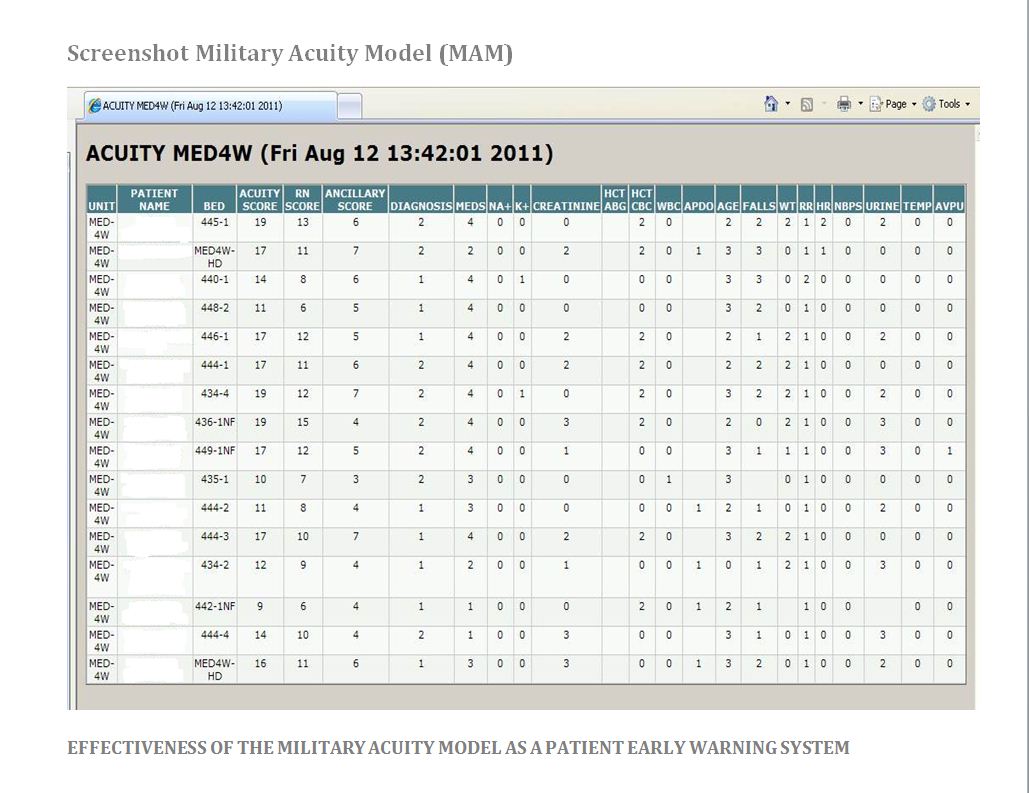
Effectiveness of the Military Acuity Model (MAM) as a patient early warning system.
The MAM was developed for the Air Force Medical Service (AFMS) to fill a void in acuity measurement. Because of the number of junior staff present in most military treatment facilities and the sheer volume of data points that must be analyzed on each patient, a more dynamic tool was developed to identify changing patient condition. The MAM monitors a series of data points in the inpatient electronic medical record (Essentris) and provides an automated acuity score for each patient. This score can then be used to identify which patients are at risk for unwanted outcomes. The repeatable and objective based acuity score, centered on the patient's condition makes the MAM a measure that can be used by all experience levels and clinical specialties. Intervention lead time will be improved as the MAM has incorporated an early warning system demonstrated to enhance recognition of patient decline up to 24 hours before full complications are obvious. It is hypothesized that the combination of the early warning score (stability measure), selected laboratory measures, medications (complexity measure and resiliency measure), and age, weight, fall risk (vulnerability measure) that make up the MAM will allow military clinicians to design and implement countermeasures to avert or minimize complications. A cognitive load balancing methodology, used in conjunction with the MAM, has the ability to identify and implement those countermeasures.
The MAM was derived from existing validated instruments and has been licensed by the Air Force for commercial use. A patent application has been filed. (Serial number 61/695,821 filed August 31, 2012 and titled "Military Medical Acuity Model.").
Research
The Military Acuity Model (MAM) research is an absolutely groundbreaking endeavor for the Military Health Service (MHS) as we currently do not enjoy a true patient acuity measurement system. We are striving to become a patient focused high performance organization, but in this arena we lack cutting edge tools to rapidly capture trends in patient decline. We have relied far too long on antiquated workload management tools to fill this void and our wounded warriors, patients and families deserve the best clinical decision support tools available. The MAM is truly unique in that it focuses on individual patient acuity, not on the tasks we perform for the patient. The confidence curve and brand loyalty we are seeking from our patients and families can be dramatically, positively impacted with this tool.
A research effort is underway to ascertain whether using the MAM in conjunction with the cognitive load balancing methodology can increase intervention lead time and reduce length of stay and unplanned intensive care unit admissions. A larger 'parent' study has been funded by Telemedicine and Advanced Technology Research Center (TATRC). The validation of the MAM in this research project is a critical step forward to propel our rapid response posture to world class performance levels.
The results of this study will provide data on whether the MAM and cognitive load balancing methodology have a possible role in the larger AFMS and Joint community as a tool to identify patients at risk. If the data support further study, implementation at other inpatient facilities throughout the Department of Defense is possible as all use Essentris (inpatient electronic medical record). This could have far reaching, positive benefits and implications (through commercialization) for Military Health Service influence in our national healthcare system and international care outreach.
9 comments
Douglas Howard • over 13 years ago
If the results of these studies are positive, the MAM could be sold commercially resulting in additional royalty payments to the MHS through the license agreement with ProcessProxy.
Mike Hopper • over 13 years ago
The MAM is based on the Heathcare Smartgrid, whose approach has helped us change the way we think about the problem of optimizing human capital and improving patient safety. Its cognitive resource model can transform Healthcare Team coordination in responding to health needs more cost-effectively throughout the MHS.
Terry Rajasenan • over 13 years ago
It is worth noting that the project can eventually become not only self-sustaining, but also offer additional resources to the Air Force, given that royalties are official (signed by Air Force and ProcessProxy on 11/15/12, agreement #: USAF ILA No. 12-320-AFMS-ILA01). There is also an IRB for it already completed at Travis AFB, so study is able to proceed to demonstrate results quickly.
Ross Birdsong • over 13 years ago
From a manpower perspective, during testing of the MAM, my unit (30 bed Surgical unit) saved an average of 110 man-hours per month over the paper-based acuity system. The MAM is completely automated and runs in the background of your EMR. My nurses truly appreciated the separation of acuity and workload as well.
Julie Hendrickson • over 13 years ago
What a great idea! A common lens for the whole clinical team based on the clinical data we already document!
Brian Anderson • over 13 years ago
yes a Common Operational Picture, like a Heads up Display, a real step forward.
Robert Connors • over 13 years ago
As a matter of additional background, I was the former Contracting Officer Representative for U.S. Army TATRC on this project, and I recommend MHS Innovation funding be provided to carry out prototype implementations within the MHS. The ProcessProxy SmartGrid methodology, which considers the concept of "cognitive capacity", is a real innovative solution to finding ways to "do more with less", while improving patient safety. By helping to identify when clinicians are reaching their "tipping points", tasks can be re-distributed to those with some excess capacity, or at least get the right tasks assigned to the right persons with the right skills sets. There is significant civilian implementation experience behind this methodology from major institutions such as John Hopkins and Newark Beth Israel. Robert E. Connors, FACHE, PMP, MS in IT, MHA. (CDR, MSC, USN, Retired, and former IPA, Henry M. Jackson Foundation for the Advancement of Military Medicine). Kudos to Colonel Doug Howard, USAF, NC, Retired for developing MAM and working with ProcessProxy throughout the course of this project. What is really interesting about this research is that MAM was developed by a military officer, was cleared through government intellectual property lawyers, and ProcessProxy is willing to pay royalties back to the government, making the project self-sustaining.
Karen Cheng • over 13 years ago
This approach offers a huge leap forward for everyone in healthcare, I'm very impressed by this data-driven approach that is timely enough to make a huge impact to improving patient care.
Billof Sale • over 13 years ago
congratulations on your win!
www.formsprintable.com/vehicle-bill-of-sale